| astronautix.com | Richards |
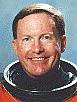
Distinguished Graduate of U.S. Naval Test Pilot School, and Naval Air Test Center Test Pilot of the Year for 1980.
Flight experience has included over 5,300 hours in 16 different types of airplanes. He has also completed more than 400 landings on board various aircraft carriers.
On his first space flight, Richards was pilot on the crew of STS-28 which launched from Kennedy Space Center, Florida, on August 8, 1989. The mission carried Department of Defense payloads and a number of secondary payloads. After 80 orbits of the Earth, this five-day mission concluded with a dry lakebed landing on Runway 17 at Edwards Air Force Base, California, on August 13, 1989. Mission duration was 121 hours 9 seconds.
Slightly more than one year later, Richards commanded the crew of STS-41. The five-man crew launched aboard the Space Shuttle Discovery on October 6 from the Kennedy Space Center, Florida, and landed at Edwards Air Force Base, California, on October 10, 1990. During 66 orbits of the Earth, the STS-41 crew successfully deployed the Ulysses spacecraft, starting this interplanetary probe on its four-year journey, via Jupiter, to investigate the polar regions of the Sun.
In June 1992, Richards commanded the crew of STS-50 aboard the Space Shuttle Columbia. STS-50 was the first flight of the United States Microgravity Laboratory and the first extended duration Orbiter flight. Over a two-week period, the STS-50 flight crew conducted a wide variety of experiments relating to materials processing and fluid physics in a microgravity environment. At that time this was the longest Space Shuttle flight in history.
In September 1994, Richards commanded the STS-64 crew aboard the Space Shuttle Discovery. Mission highlights included: the first use of a space based laser for environmental research; deployment and retrieval of a spacecraft in support of solar wind and corona studies; robotic processing of semiconductors; maneuvered the robotic arm in close proximity to over 100 Shuttle reaction control system jet firings to measure forces imparted to a plume detection instrument in support of future Space Station/Shuttle rendezvous flights; first untethered spacewalk in 10 years to test a self-rescue jetpack. Mission duration was 10 days, 22 hours, 51 minutes.
In April 1995, Captain Richards left the Astronaut Office and is now assigned to the Space Shuttle Program Office at the Johnson Space Center. He has been designated as the Mission Director/Manager for the second Hubble Space Telescope Servicing Space Shuttle Mission (STS-82), and Mission Manager for the second Tethered Satellite System Space Shuttle mission (STS-75).
Planned Astro-1 shuttle mission. Cancelled after Challenger disaster.
Manned five crew. Deployed 2 classified satellites. Landed at: Runway 17 dry lake bed at Edwards Air Force Base, . Landing Speed: 287 kph. Touchdown miss distance: 1,618.00 m. Landing Rollout: 1,833.00 m. Payloads: DoD Mission.
Manned five crew. Deployed Ulysses spacecraft. Payloads: Deploy Ulysses, Shuttle Solar Backscatter Ultraviolet, Intelsat Solar Array Coupon, Solid-Surface Combustion Experiment, Investigations Into Polymer Membrane Processing, Chromo-some and Plant Cell Division in Space, Physiological Systems Experiment, Voice Command System, Radiation Monitoring Equipment III, Air Force Maui Optical Site.
Carried United States Microgravity Laboratory. First extended-duration mission. Payloads: United States Microgravity Laboratory (USML)-1; Orbital Acceleration Research Experiment (OARE); Investigations Into Polymer Membrane Processing (IPMP), Shuttle Amateur Radio Experiment (SAREX)-ll; Ultraviolet Plume Instrument (UVPl) .
Payloads: Lidar In-Space Technology Experiment (LITE), Shuttle Pointed Autonomous Research Tool for Astronomy (SPARTAN) 201-II, Robot-Operated Materials Processing System (ROMPS), Shuttle Plume Impingement Flight Experiment (SPIFEX), getaway special (GAS) bridge assembly with ten GAS experiments, Trajectory Control Sensor (TCS), Simplified Aid for EVA Rescue (SAFER), Solid Surface Combustion Experiment (SSCE), Biological Research in Canisters (BRIC) III, Radiation Monitoring Experiment (RME) III, Military Applications of Ship Tracks (MAST), Shuttle Amateur Radio Experiment (SAREX) II, Air Force Maui Optical Site (AMOS) Calibration Test.
Discovery was launched on mission STS-102 (Space Station flight 5A.1) into an initial 60 x 222 km x 51.6 deg orbit. The mission was delivery of supplies and equipment, and changeout of the Expedition One and Expedition Two station crews. STS-102 carried the Leonardo Multi Purpose Logistics Module (MPLM), built by Alenia Spazio (Torino), to the International Space Station. The MPLM was a descendant of the Spacelab long modules. Also carried was a Spacehab/Energia unpressurized Integrated Cargo Carrier with LCA/MTSAS-A, RU, and PFCS. A sidewall adapter beam with two GAS canisters (G-783 and WSVFM) was also on board. WSVFM measured vibration during launch. Another adapter beam, probably at the rear of the payload bay, carried SEM-9. SEM-9 and G-783 contained high school microgravity experiments.
Leonardo carried 16 'racks' of equipment, including the Human Research Facility Rack (Rack 13) which allowed the astronauts to do extensive medical experiments, the CHeCS Rack (28), the DDCU-1 and DDCU-2 racks (7 and 9), the Avionics-3 (Rack 6), and the MSS Avionics/Lab (Rack 11) and Avionics/Cupola (Rack 12) racks for a total of 7 equipment racks to be installed on Destiny. Three Resupply Stowage Racks (50, 51, 52) and four Resupply Stowage Platforms (180, 181, 182 and 188) remained installed on Leonardo, with their equipment bags being individually transferred to the Station. System Racks 2, 3, 4, 5 and 8 were already on Destiny together with stowage racks 110 through 117. Each rack had a mass of 150-300 kg.
The orbiter fired its OMS engines at 1221 GMT to raise the orbit to 185 x 219 km. Discovery docked with the PMA-2 port on the Station at 0639 GMT on March 10. The LCA (Lab Cradle Assembly) was attached to Destiny's +Z side during an EVA. It was to be used on the next mission to temporarily place a Spacelab pallet on Destiny during installation of the Station's robot arm. Later, it would be the site for the main Station truss, beginning with segment S0.
The PMA-3, on Unity at the -Z nadir position, had to be moved to the port position to make room for Leonardo. An external stowage platform was attached to Destiny and the External Stowage Platform and the PFCS Pump Flow Control System were added to the port aft trunnion on Destiny. A rigid umbilical (RU) was connected to the PDGF grapple fixture on Destiny to support the Station's future robot arm. Leonardo was docked to Unity at -Z for a while so that its cargo could be transferred to the station easily; it was then be returned to the payload bay and brought back to earth.
At 0232 GMT on March 19 command of ISS was transferred to Expedition 2 and the hatches were closed. Discovery undocked at 0432 GMT and flew once around the station before departing at 0548 GMT. ISS mass after undocking was 115527 kg. The OMS engines fired for the deorbit burn at 0625 GMT on March 21, and Discovery touched down on runway 15 at Kennedy Space Center at 0731 GMT.