| astronautix.com | Ochoa |
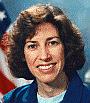
Selected by NASA in January 1990, Dr. Ochoa became an astronaut in July 1991. Her technical assignments to date include flight software verification in the Shuttle Avionics Integration Laboratory, crew representative for flight software and computer hardware development, and crew representative for robotics development, testing, and training. A veteran of two space flights, Dr. Ochoa has logged over 484 hours in space. Since returning from STS-66, she has been working on the International Space Station program. She is currently the Assistant for Station to the Chief of the Astronaut Office, directing crew involvement in the development and operation of the Station..
In April 1993, Dr. Ochoa flew as a Mission Specialist on STS-56, carrying ATLAS-2. During this 9-day mission the crew of Discovery conducted atmospheric and solar studies in order to better understand the effect of solar activity on the Earth's climate and environment. Dr. Ochoa used the Remote Manipulator System (RMS) to deploy and capture the Spartan satellite, which studied the solar corona.
Dr. Ochoa was the Payload Commander on the STS-66 Atmospheric Laboratory for Applications and Science-3 mission (November 3-14, 1994). ATLAS-3 continues the series of Spacelab flights to study the energy of the Sun during an 11-year solar cycle and to learn how changes in the sun's irradiance affect the Earth's climate and environment. Dr. Ochoa used the RMS to retrieve the CRISTA-SPAS atmospheric research satellite at the end of its 8-day free flight.
Manned five crew. Carried Atlas-2; deployed and retrieved Spartan 201. Payloads: Atmospheric Laboratory for Applications and Science (ATLAS) 2, Shuttle Solar Backscat-ter Ultraviolet (SSBUV) A, Shuttle Pointed Autonomous Research Tool for Astronomy (SPARTAN) 201 (Solar Wind Generation Experi-ment), Solar Ultraviolet Experiment (SUVE), Commercial Material Dispersion Apparatus (CMIX), Physiological and Anatomical Rodent Experiment (PARE), Hand-held, Earth-oriented, Real-time, Cooperative, User-friendly, Location-targeting, and Environmental System (HER-CULES), Shuttle Amateur Radio Experiment (SAREX) II, Space Tissue Loss (STL), Air Force Maui Optical Site (AMOS), Cosmic Radiation Effects and Activation Monitor (CREAM), Radiation Monitoring Equipment (RME) III.
Carried Atlas-3 laboratory; deployed and retrieved CRISTA-SPAS. Payloads: Atmospheric Laboratory for Applications and Science (ATLAS) 3, Cryogenic Infrared Spectrometers and Telescopes for the Atmo-sphere (CRISTA)-Shuttle Pallet Satellite (SPAS) 1, Experiment of the Sun for Complement-ing the ATLAS Payload for Education (ESCAPE) II, Inter-Mars Tissue Equivalent Proportional Counter (ITEPC), Shuttle Solar Backscatter Ultraviolet (SSBUV) A, Physiological and Anatomical Rodent Experiment (PARE/NIH-R), Protein Crystal Growth (PCG-TES and PCG-STES), Space Tissue Loss (STL/NIH-C-A), Shuttle Acceleration Measurement System (SAMS), Heat Pipe Performance (HPP).
Discovery docked at the PMA-2 end of the International Space Station PMA-2/Unity/PMA-1/Zarya stack. The crew transferred equipment from the Spacehab Logistics Double Module in the payload bay to the interior of the station. Tammy Jernigan and Dan Barry made a space walk to transfer equipment from the payload bay to the exterior of the station. The ODS/EAL docking/airlock truss carried two TSA (Tool Stowage Assembly) packets with space walk tools. The Integrated Cargo Carrier (ICC), built by Energia and DASA-Bremen, carried parts of the Strela crane and the US OTD crane as well as the SHOSS box which contains three bags of tools and equipment to be stored on ISS's exterior.
The STS-96 payload bay manifest:
On May 30 at 02:56 GMT Tammy Jernigan and Dan Barry entered the payload bay of Discovery from the tunnel adapter hatch, and made a 7 hr 55 min space walk, transferring equipment to the exterior of the station.
On May 31 at 01:15 GMT the hatch to Unity was opened and the crew began several days of cargo transfers to the station. Battery units and communications equipment were replaced and sound insulation was added to Zarya. Discovery undocked from ISS at 22:39 GMT on June 3 into a 385 x 399 km x 51.6 degree orbit, leaving the station without a crew aboard. On June 5 the Starshine satellite was ejected from the payload bay. The payload bay doors were closed at around 02:15 GMT on June 6 and the deorbit burn was at 04:54 GMT. Discovery landed on runway 15 at Kennedy Space Center at 06:02 GMT.