| astronautix.com | Lucid |
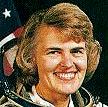
Dr. Lucid is a commercial, instrument, and multi-engine rated pilot.
STS-51G Discovery (June 17-24, 1985) was a 7-day mission during which crew deployed communications satellites for Mexico (Morelos), the Arab League (Arabsat), and the United States (AT&T Telstar). They used the Remote Manipulator System (RMS) to deploy and later retrieve the SPARTAN satellite which performed 17 hours of x-ray astronomy experiments while separated from the Space Shuttle. In addition, the crew activated the Automated Directional Solidification Furnace (ADSF), six Getaway Specials, and participated in biomedical experiments. The mission was accomplished in 112 orbits of the Earth, traveling 2.5 million miles in 169 hours and 39 minutes. Landing was at Edwards Air Force Base (EAFB), California.
STS-34 Atlantis (October 18-23, 1989) was a 5-day mission during which she deployed the Galileo spacecraft on its journey to explore Jupiter, operated the Shuttle Solar Backscatter Ultraviolet Instrument (SSBUV) to map atmospheric ozone, and performed numerous secondary experiments involving radiation measurements, polymer morphology, lightning research, microgravity effects on plants, and a student experiment on ice crystal growth in space. The mission was accomplished in 79 orbits of the Earth, traveling 1.8 million miles in 119 hours and 41 minutes. Landing was at Edwards Air Force Base, California.
STS-43 Atlantis (August 2-11, 1991) was a nine-day mission during which the crew deployed the fifth Tracking and Data Relay Satellite (TDRS-E). The crew also conducted 32 physical, material, and life science experiments, mostly relating to the Extended Duration Orbiter and Space Station Freedom. The mission was accomplished in 142 orbits of the Earth, traveling 3.7 million miles in 213 hours, 21 minutes, 25 seconds. STS-43 Atlantis was the eighth Space Shuttle to land at KSC).
STS-58 Columbia (October 18 to November 1, 1993). This record duration fourteen-day mission was recognized by NASA management as the most successful and efficient Spacelab flight flown by NASA. The STS-58 crew performed neurovestibular, cardiovascular, cardiopulmonary, metabolic, and musculoskeletal medical experiments on themselves and 48 rats, expanding our knowledge of human and animal physiology both on earth and in space flight. In addition, they performed 16 engineering tests aboard the Orbiter Columbia and 20 Extended Duration Orbiter Medical Project experiments. The mission was accomplished in 225 orbits of the Earth, traveling 5.8 million miles in 336 hours, 13 minutes, 01 seconds. Landing was at Edwards Air Force Base, California. In completing this flight Dr. Lucid logged 838 hours, 54 minutes in space making her America's female space traveler with the most hours in space.
Dr. Lucid currently holds the United States single mission space flight endurance record on the Russian Space Station Mir. Following a year of training in Star City, Russia, her journey started with liftoff at Kennedy Space Center, Florida, on March 22, 1996 aboard STS-76 Atlantis. Following docking, she transferred to the Mir Space Station. Assigned as a Board Engineer 2, she performed numerous life science and physical science experiments during the course of her stay aboard Mir. Her return journey to KSC was made aboard STS-79 Atlantis on September 26, 1996. In completing this mission Dr. Lucid traveled 75.2 million miles in 188 days, 04 hours, 00 minutes, 14 seconds.
Planned shuttle mission. Cancelled due to payload delays.
Deployed and retrieved Spartan 1; launched Morelos 1, Arabsat 1B, Telstar 3D.Payloads: Shuttle Pointed Autono-mous Research Tool for Astronomy (SPARTAN)-1; Automated Directional Solidification Furnace (ADSF); High Precision Tracking Experiment (HPTE); Orbiter Experiments (OEX); French Echocardiograph Experiment (FEE) and French Pocket Experiment (FPE).
Manned five crew. Deployed Galileo .Payloads: Deploy IUS with Galileo spacecraft. Shuttle Solar Backscatter Ultraviolet (SSBUV), Polymer Morphology (PM) experiments, IMAX camera project, Mesoscale Lightning Experiment (MLE), Air Force Maui Optical Site (AMOS) experiment, Growth Hormone Concentration and Distribution (GHCD) in Plants experiment, Sensor Technology Experiment (STEX), SSIP Student Experiment (SE) 82-15, Ice Crystals Experiment. First flight at this inclination.
Manned five crew. Deployed TDRS 5 satellite. Payloads: Tracking and Data Relay Satellite (TDRS)-E/lnertial Upper Stage (lUS), Space Station Heatpipe Advanced Radiator Element (SHARE)-ll, Shuttle Solar Backscatter Ultraviolet (SSBUV) instrument 03, Optical Communications Through the Shuttle Window (OCTW), Air Force Maui Optical Site (AMOS) Calibration Test, Auroral Photography Experiment (APE)-B, Bioserve-lnstrumentation Technology Associates Materials Dispersion Apparatus (BlMDA)-02, Investigations Into Polymer Membrane Processing (IPMP)-03, Protein Crystal Growth Ill Block Il, Space Acceleration Measure-ment System (SAMS), Solid Surface Combustion Experiment (SSCE)-02, Tank Pressure Control Experiment (TPCE).
Biological, microgravity experiments aboard Spacelab 2. Payloads: Spacelab Life Sciences (SLS) 2, Shuttle Amateur Radio Experiment (SAREX) II.
Shuttle-Mir Mission 3. Docked with the Mir space station 24 March 1996; Shannon Lucid was left on Mir for an extended stay. First American EVA on Mir. Payloads: SPACEHAB/Mir 03; KidSat; Shuttle Amateur Radio Experiment (SAREX) II, Configuration M; RME 1304�Mir/ Environmental Effects Payload (MEEP); orbiter docking system RME 1315; Trapped Ions in Space Experiment (TRIS); Extravehicular Activity Development Flight Test (EDFT) 04.