| astronautix.com | Hauck |
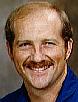
NAME: Frederick (Rick) Hauck (pronounced HOWK) (Captain, USN)
NASA Astronaut
BIRTHPLACE AND DATE: Born April 11, 1941, in Long Beach, California, but considers Winchester, Massachusetts, and Washington, D.C., to be his hometowns. His parents were the late Captain and Mrs. Philip F. Hauck.
PHYSICAL DESCRIPTION: Blond hair; blue eyes; height: 5 feet 9 inches; weight: 175 pounds.
EDUCATION: Graduated from St. Albans High School in Washington, D.C. in 1958; received a bachelor of science degree in Physics from Tufts University in 1962 and a master of science degree in Nuclear Engineering from Massachusetts Institute of Technology in 1966.
MARITAL STATUS: Married to the former Dolly Bowman of Washington, D.C.
CHILDREN: Ms. Whitney Hauck Wood; Ens. Stephen Cristopher Hauck, USN.
RECREATIONAL INTERESTS: During his spare time, he enjoys skiing, sailing, squash, and working on his 1958 Corvette.
ORGANIZATIONS: Associate fellow, the American Institute of Aeronautics and Astronautics, and the Society of Experimental Test Pilots.
SPECIAL HONORS: The Defense Distinguished Service Medal; the Distinguished Flying Cross; the Air Medal (9); the Navy Commendation Medal with Gold Star and Combat V; the NASA Distinguished Service Medal; the NASA Medal for Outstanding Leadership; the NASA Space Flight Medal (2); the Presidential Cost Saving Commendation; the AIAA Haley Space Flight Award; Lloyd's of London Silver Medal for Meritorious Service; the American Astronautical Society Flight Achievement Award; the Federation Aeronautique Internationale (FAI) Yuri Gagarin Gold Medal; the FAI Komarov Diploma (2); the Tufts University Presidential Medal; and the Delta Upsilon Distinguished Alumnus Award. He was named the Navy's Outstanding Test Pilot for 1972.
EXPERIENCE: Hauck, a Navy ROTC student at Tufts University, was commissioned upon graduation in 1962 and reported to the USS WARRINGTON (DD-843) where he served 20 months as communications officer and CIC officer. In 1964, he attended the U.S. Naval Postgraduate School, Monterey, California, for studies in math and physics and, for a brief time in 1965, studied Russian at the Defense Language Institute in Monterey. Selected for the Navy's Advanced Science Program, he received his master's degree in Nuclear Engineering from MIT the next year.
He commenced flight training at the Naval Air Station, Pensacola, Florida, in 1966, and upon receiving his wings in 1968, he reported to the Naval Air Station at Oceana, Virginia, for replacement pilot training in the A-6. As a pilot with YA-35 he deployed to the Western Pacific with Air Wing 15 aboard USS CORAL SEA (CVA-43), flying 114 combat and combat support missions.
In August 1970 Hauck returned to the east coast A-6 replacement training squadron, VA-42, as a visual weapons delivery instructor. Selected for test pilot training, he reported to the U.S. Naval Test Pilot School at Patuxent River, Maryland, in 1971. A 3-year tour in the Naval Air Test Center's Carrier Suitability Branch of the Flight Test Division followed. During this tour, Hauck served as a project test pilot for automatic carrier landing systems in the A-6, A-7, F-4, and F-14 aircraft and was team leader for the Navy Board of Inspection and Survey aircraft carrier trials of the F-14. In 1974, he reported as operations officer to Commander Carrier Air Wing 14 aboard USS ENTERPRISE (CV(N)-65). During this tour, he flew the A-6, A-7, and F-14 during both day and night carrier operations. He reported to Attack Squadron 145 as executive officer in February 1977, following a brief tour in VA-128.
Hauck has logged over 5,500 hours flying time.
NASA EXPERIENCE: Hauck was selected as an astronaut candidate by NASA in January 1978. In August 1979, he completed a 1-year training and evaluation period qualifying him for assignment as a pilot on future Space Shuttle flight crews. He was a member of the support crew for STS-1, the first Shuttle Orbiter mission, and was the reentry capsule communicator (CAPCOM) on the support crew for STS-2. Subsequently he was a project test pilot for development of flight techniques and landing aids in preparation for the first orbiter night landing.
Hauck was pilot for STS-7, which launched from Kennedy Space Center, Florida, on June 18, 1983. The crew included Bob Crippen (spacecraft commander), and three mission specialists, John Fabian, Sally Ride, and Norman Thagard. This was the second flight for the Orbiter Challenger and the first mission with a 5-person crew. During the mission, the STS-7 crew deployed satellites for Canada (ANIK C-2) and Indonesia (PALAPA B-1); operated the Canadian-built Remote Manipulator System (RMS) to perform the first deployment and retrieval exercise with the Shuttle Pallet Satellite (SPAS-01); conducted the first formation flying of the orbiter with a free-flying satellite (SPAS-01); carried and operated the first U.S./German cooperative materials science payload (OSTA- 2); operated the Continuous Flow Electrophoresis System (CFES) and the Monodisperse Latex Reactor (MLR) experiments, and activated seven Getaway Specials. Mission duration was 147 hours before landing on a lakebed runway at Edwards Air Force Base, California, on June 24, 1983.
Hauck was next spacecraft commander of STS 51-A which launched from Kennedy Space Center, Florida, on November 8, 1984. His crew included Dave Walker (pilot), and three mission specialists, Joe Allen, Anna Fisher, and Dale Gardner. This was the second flight of the Orbiter Discovery. During the mission the crew deployed two satellites, Telesat Canada's Anik D-2 and Hughes' LEASAT-1 (Syncom IV-1), and operated the 3M Company's Diffusive Mixing of Organic Solutions (DMOS) experiment. In the first space salvage mission in history the crew also retrieved for return to earth the Palapa B-2 and Western VI satellites. STS 51-A completed 127 orbits of the Earth before landing at Kennedy Space Center, Florida, on November 16, 1984.
In March 1985 Captain Hauck became the Astronaut Office Project Officer for the integration of the liquid fueled Centaur upper stage into the Space Transportation System. In May 1985 he was named Commander of the Ulysses solar probe mission (sponsored by the European Space Agency). After the Challenger accident this mission was postponed, and the Shuttle Centaur project was terminated. In August 1986 Captain Hauck was appointed NASA Associate Administrator for External Relations, Washington D.C. He resumed his astronaut duties at the Johnson Space Center in early February 1987.
Hauck was the spacecraft commander on STS-26, the first flight to be flown since the Challenger accident. The Orbiter Discovery was launched from the Kennedy Space Center, Florida, on September 29, 1988. The crew on board the Discovery included the pilot, Dick Covey, and three mission specialists, Dave Hilmers, Mike Lounge, and Pinky Nelson. During the 4-day mission, the crew successfully deployed a Tracking and Data Relay Satellite (TDRS-C), which was subsequently carried to orbit by the Inertial Upper Stage (IUS) rocket. They also operated eleven mid-deck experiments. Discovery completed 64 orbits of the earth before landing at Edwards Air Force Base, California, on October 3, 1988. Mission duration was 97 hours. With the completion of his third space flight, Hauck has logged a total of 436 hours in space.
Captain Hauck left NASA in March 1989. He is currently Director, Navy Space Systems (OP-943), Department of the Navy.
NOVEMBER, 1989
Manned five crew. Deployed Anik C2, Palapa B1; deployed and retrieved SPAS platform. Payloads: Office of Space and Terrestrial Applications (OSTA)-2 experiments, deployment of PALAPA-B1 communications satellite for Indonesia with Payload Assist Module (PAM)-D and Telesat-F communications satellite for Canada with PAM-D, German Shuttle Pallet Satellite (SPAS)-01, seven getaway specials (GAS), Monodisperse Latex Reactor (MLR), Continuous Flow Electrophoresis System (CFES).
Planned Department of Defense or TDRS deployment shuttle mission. Cancelled due to IUS failure.
Manned five crew. First retrieval of two satellites (PALAPA B-2 and WESTAR Vl) for return to earth. Deployed Anik D2, Leasat 2; recovered Westar 6, Palapa B2. Payloads: Telesat (Canada communications satellite)-H with Payload Assist Module (PAM)-D deploy-ment, Syncom IV-1 communications satellite deployment with its unique stage, retrieval of PALAPA B-2 and WESTAR VI communications satellites with PAM-D which failed to ignite on the STS-41-B mission. Manned maneuvering unit (MMU) used for retrieval. Diffusive Mixing of Organic Solutions (DMOS) experiment.
Planned shuttle mission for deployment of Ulysses spacecraft. Cancelled after Challenger disaster.
Manned five crew. First shuttle reflight after Challenger disaster. Deployed TDRS 3. Payloads: Deploy IUS (lnertial Upper Stage) with Tracking and Data Relay Satellite (TDRS)-C. 3M's Physical Vapor Transport Organics Solids 2 experiment (PVTOS), Automated Directional Solidification Furnace (ADSF), Infrared Communi-cations Flight Experiment (lRCFE), Protein Crystal Growth Il (PCG), Isoelectric Focusing (ISF)-2, Phase Partitioning Experiment (PPE), Aggrega-tion of Red Blood Cells (ARC)-2, Mesoscale Lightning Experiment (MLE)-1, Earth Limb Radiance (ELRAD), Orbiter Experiments (OEX), Autonomous Supporting Instrumentation System (OASlS)-I, two Shuttle Student Involvement Project (SSIP) experiments.