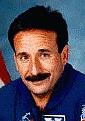
Upon completing his B.S. degree from the Polytechnic Institute of Brooklyn, Camarda began work for NASA's Langley Research Center, Hampton, Virginia, in 1974. He was a research scientist in the Thermal Structures Branch of the Structures and Materials Division and was responsible for demonstrating the feasibility of a heat-pipe-cooled leading edge for Space Shuttle by analysis, laboratory experiments, and aerothermal testing in Langley's 8-foot High Temperature Tunnel. He conducted analytical and experimental research in heat pipes, structural mechanics and dynamics, heat transfer, and numerical optimization for aircraft, spacecraft, and space launch vehicles. While at Langley, Camarda earned his masters degree from George Washington University in Engineering Science with emphasis on mechanics of composite structures at elevated temperature and his doctorate degree from Virginia Polytechnic Institute and State University with emphasis on the development of advanced modal methods for efficiently predicting transient thermal and structural performance. In 1989, Camarda was selected to lead the Structures and Materials Technology Maturation Team for the National Aero-Space Plane (NASP) program which was responsible for maturing materials and structures technologies necessary to enable the development of an airbreathing hypersonic vehicle capable of horizontal take-off to orbit. Camarda was selected to head the Thermal Structures Branch (TSB) in 1994 with responsibility for a research engineering staff, two major focused programs (the high-speed research (HSR) and reusable launch vehicle (RLV) programs), and several structural test facilities including the Thermal Structures Laboratory. Some of the primary responsibilities of the TSB is the development of durable, lightweight metallic thermal protection systems (TPS), reusable cryogenic tank systems, and graphite-composite primary structure for RLV. Camarda has received over 18 NASA awards for technical innovations and accomplishments. He also received a Research and Development 100 award from Industrial Research Magazine for one of the top 100 technical innovations of 1983 entitled "Heat-Pipe-Cooled Sandwich Panel." He holds four patents and has two patents pending.Dr. Camarda was selected as an astronaut candidate by NASA in April 1996. He reported to the NASA Johnson Space Center in August 1996 to begin two years of training and evaluation. Successful completion of initial training will qualify him for various technical assignments leading to selection as a mission specialist on a Space Shuttle flight crew.