| astronautix.com | Allen Andy |
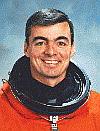
Official NASA Biography - 1997
He has logged over 6,000 flight hours in more than 30 different aircraft.
Allen retired from the Marine Corps and left NASA in October 1997. He currently serves as President of the FIRST Foundation. The FIRST (For Inspiration and Recognition of Science and Technology) Foundation, based out of Manchester, New Hampshire, promotes youth interest in science and technology.
STS-62, a 14-day mission aboard Space Shuttle Columbia consisted of 5 crew members who conducted a broad range of science and technology experiments with Earth applications to materials processing, biotechnology, advanced technology, and environmental monitoring. Principal payloads of the mission were the United States Microgravity Payload 2 (USMP-2) and the Office of Aeronautics and Space Technology 2 (OAST-2) package. STS-62 launched March 4, 1994 and landed at the Kennedy Space Center, Florida, on March 18, 1994. The flight completed 224 orbits covering 5.8 million miles in 335.3 hours.
STS-75 (February 22 to March 9, 1996), was a 15-day mission with principal payloads being the reflight of the Tethered Satellite System (TSS) and the third flight of the United States Microgravity Payload (USMP-3). The TSS successfully demonstrated the ability of tethers to produce electricity. The TSS experiment produced a wealth of new information on the electrodynamics of tethers and plasma physics before the tether broke at 19.7 km, just shy of the 20.7 km goal. The crew also worked around the clock performing combustion experiments and research related to USMP-3 microgravity investigations used to improve production of medicines, metal alloys, and semiconductors. The mission was completed in 252 orbits covering 6.5 million miles in 377 hours and 40 minutes.
Manned seven crew. Deployed Eureca-1; failed to deploy Italian tether probe TSS-1. Payloads: Tethered Satellite System (TSS)-1; European Retrievable Carrier (EURECA)-1L; Evaluation of Oxygen Integration with Materials (EOlM)-lll/ Thermal Energy Management Processes (TEMP)-2A; Consortium for Materials Development In Space Complex Autonomous Payloads (CONCAP)-ll and Ill; IMAX Cargo Bay Camera (ICBC); Limited Duration Space Environment Candidate Materials Exposure (LDCE); Pituitary Growth Hormone Cell Function (PHCF); Ultravio-let Plume Instrument (UVPl).
Carried USMP-2, OAST-2, SAMPIE, TES, EISG. Payloads: United States Microgravity Payload (USMP) 2, Office of Aeronautics and Space Technology (OAST) 2, Dexterous End Effector (DEE), Shuttle Solar Backscatter Ultraviolet/A (SSBUV/A), Limited-Duration Space Environment Candidate Material Exposure (LDCE), Advanced Protein Crystal Growth (APCG), Physiological Systems Experiment (PSE), Commercial Protein Crystal Growth (CPCG), Commercial Generic Bioprocessing Apparatus (CGBA), Auroral Photography Experiment Phase B (APE-B), Middeck Zero-Gravity Dynamics Experiment (MODE), Air Force Maui Optical Site (AMOS) Calibration Test, Bioreactor Demonstration System A.
Carried TSS-1R tether satellite; satellite tether broke during deployment, making TSS-1R an unintentional free flyer
Payloads: Tethered Satellite System (TSS) Reflight (1R); Orbital Acceleration Research Experiment (OARE) (part of United States Microgravity Payload 3); USMP-3; Commercial Protein Crystal Growth (CPCG) 09, Block IV; Middeck Glovebox Experiment (MGBX) (part of USMP-3). During the deployment of TSS, the tether broke and the satellite was lost.