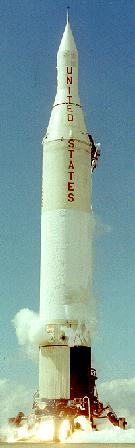
10,250 bytes. 135 x 448 pixels.
| astronautix.com | Double Base Solid Propellants |
|
| Juno 2 - Juno 2 - COSPAR 1959-Iota 10,250 bytes. 135 x 448 pixels. |
Double-base solid propellants consist mainly of fibrous nitro-cellulose and a gelatiniser, or plasticiser, such as nitro-glycerine or a similar compound (ethylene glycol dinitrate), each containing oxygen and fuel in the same compound. The term double-base originated from the application of these mixtures as gun propellants. They contained two active constituents, and this name distinguished them from the "single base" smokeless powders which utilised either nitro-cellulose (gun cotton) or nitro-glycerine singly as the active constituent.
The first double-base propellant was made by Alfred Nobel in 1888, and was used as a smokeless powder. In such propellants, a high nitro-glycerine content tends to increase the energy and burning rate; a high nitro-cellulose content helps to impart a strength to the propellant. The first experiments with double-base smokeless powders as rocket propellant seem to have been made by Goddard in 1918 and by F W Sander in Germany around 1935. The results did not appear to be very promising.
Walter Dornberger, Chief of German rocketry reported: "In 1930.... I got the order to make military weapons out of solid rockets, using, if possible, smokeless powder. This was to be accomplished in military facilities... These solid rocket weapons were ready for mass production as early as 1934".
In Russia, N I Tikhomirov and I P Grave independently proposed to use smokeless powder in rockets before World War I, but these proposals received no official support. After 1917 the attitude changed sharply. Even during the Civil War, engineers N I Tikhomirov and V A Artem'ev started work on the design of smokeless powder rocket and in 1921 a special laboratory was set up for these studies in Moscow. They became convinced of the necessity of creating a special, slow-burning rocket powder. In 1924, O.G. Filippov and S.A. Serikov, pyrotechnic specialists working at the Artillery Academy then located in Leningrad, developed a formula for a new type of powder based on a non-volatile solvent: 76.5% by weight of nitro-cellulose, 23% TNT, and 0.5% centralite to retard burning. It was called "PTP", i.e. Pyroxyline TNT Powder. By 1928-29, the work conducted in the Artillery Academy permitted development of a semi-production technique for preparing the PTP. A rocket was designed using these solid charges and it was successfully tested on March 3, 1928. In 1929 the basic 24mm solid charges made from PTP, which were prepared in the laboratory shops in great quantities, were selected as the standard in Gas Dynamics Laboratory, the new formed GDL. Therefore, on this standard engineers developed three basic sizes of scaled-up rocket chambers of 68, 82, and 132mm calibre. The latter two subsequently became the basic calibre of Soviet rockets for decades: the RS-82 and the RS-132, later named "Katyusha". An 82mm Jet-Assisted Takeoff rocket was flight tested on the Y-1 and TB-1 aircraft in 1932-33.
In the USSR after World War II, 0.5 ton, 300-400mm rocket motor charges of double-base ballistite were produced for various rockets and missiles. In 1959 the NII-125 (now NPO Soyuz of Liouberetsky) suggested to build ballistite charges of 4 to 5 tons, 1 meter in diameter and 5 to 6 meters long. Korolev then begin to study the RT-1/8K95 predecessor of the RT-2/8K98 ICBM (alias SS-13 Savage) with 4 X 800mm charges of ballistite as the first stage. The fibreglass cluster produced 100 tons of thrust for 30 seconds. But flight tests of the RT-1 from April 1962 to June 1963 at Kapustin Yar were not very successful. The project was cancelled.
In Great Britain, in December 1934 Alvyn Douglas Crow, Director of Ballistic Research at the Woolwich Royal Arsenal, proposed to Sir Hugh Elles, Master of General Ordnance, that the British begin to investigate the possibilities of developing rocket weapons powered by smokeless cordite powder of the unrestricted burning type. Work began in May 1935 and by the summer of 1936 encouraging advances in technique had been achieved. Ultimately Crow headed Britain' wartime rocket program.
In the United States, Parsons and Forman of GALCIT (Guggenheim Aeronautical Laboratory, California Institute of Technology) in 1938 built and tested a smokeless powder constant-volume combustion motor similar to the one that had been used by Goddard. They concluded after these tests that the mechanical complications of constructing an engine using successive impulses to obtain thrust duration of over 10 seconds was impractical. During 1939 and 1940, various mixtures of smokeless powder with black powder (the first double-base/composite propellant) were tested. Most of the tests ended in an explosion. There were those who were convinced that the combustion process of a restricted burning charge in a rocket motor was basically unstable.
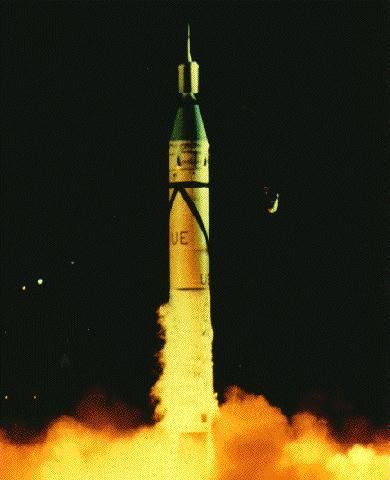 | Jupiter C Credit: NASA. 18,748 bytes. 390 x 480 pixels. |
Because of it very little experience in high-energy solid (double-base) propellants of the type needed for extended-range, high-speed weapons, the United States drew on British rocket knowledge. Within a few years, suitable solid propellants were being produced at the Army's Radford Ordnance Works, the Navy's Indian Head Powder Factory, and the Sunflower Ordnance Works, operated by the Hercules Powder Company. Later, the Section H group moved to the Allegheny Ballistics Laboratory at nearby Pinto, West Virginia, where they worked closely with Army Ordnance, the Chemical Warfare Service, and the Air Corps. Various double-base rockets were produced during World War II including bazooka rockets, 4.5 inch, 5 inch, and 7.2 inch rockets, and the large air-launched Tiny Tim. The Tiny Tim was 11.75 inches in diameter and was later utilised as the booster for the Wac Corporal research rocket (ancestor of Aerobee and Corporal, the first big all-American liquid rocket, guided ballistic missile).
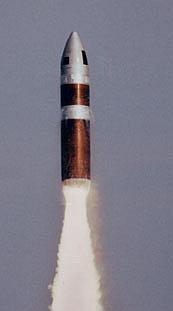 | Poseidon C3 Credit: Lockheed-Martin. 4,484 bytes. 173 x 311 pixels. |
The Bumblebee program lead directly to the Navy's Terrier and Talos missiles as follow-ons of the Lark anti-aircraft research missile. The Army's Nike-Ajax was a kind of large, guided Wac Corporal, using the same propulsion formula, but with a Bell liquid pressure feed rocket main engine. Bell later developed the pump feed rocket engine XLR65-BA-1 for the X-9 Shrike, predecessor of the Rascal air-to-ground missile. Yet another derivative was a simpler engine for a rocket-propelled pod for the B-58 Hustler bomber. The rocket pod was cancelled, but the Hustler became the basic Agena engine used on upper stages of the Thor, Atlas and Titan boosters. Bell was later involved in the ascent engine development for the Apollo lunar module.
Talos and Honest John motors were used on the big three and four stage Black Brant XI and XII NASA sounding rockets with composite upper stages. The Honest John motor was know as Taurus when used on sounding rockets.
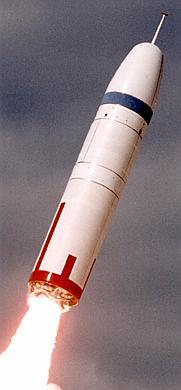 | Poseidon C4 Credit: Lockheed-Martin. 10,243 bytes. 181 x 390 pixels. |
Hercules Powder is today Alliant Techsystems and builds composite boosters for the Titan IVB, Delta II, Delta III, and the future Delta IV; all stages for Pegasus; and upper stages for the Taurus space launchers. Hercules was a pioneer in the development of fibre-wound light motor cases for Minuteman and Polaris motors.
In the late 1950's and early 1960's, Aerojet tried to develop nitro-urethane as a double-base high energy replacement, but nitrourethane had bad mechanical properties. In the end it has proved that pure double-base propellants are better for the environment than composites, but they are explosive and have relatively low specific impulse (higher with explosive HMX-nitramine added). For safety reasons they are not suited for big space launchers.
Although most solid propellants used today are classed as composites, the double-base (homogeneous) type is still much in demand. However, the gradual increase in the number and amount of additives to the original single-phase double-base propellant has narrowed the distinction between the two classes. Initially the double-base propellant was a homogeneous solid or liquid single-phase chemical system that contained enough oxidiser to sustain combustion in the same molecule with fuel.
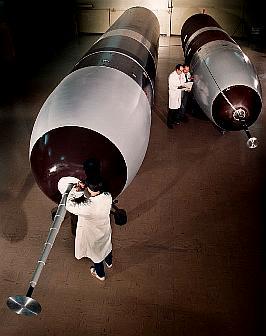 | Poseidon C4 and D5 Credit: Lockheed-Martin. 16,431 bytes. 266 x 336 pixels. |
MAJOR HERCULES MOTORS.
----------------------------------------------------
Rocket       Motor  Dia    Length   Thrust    Weight
project       name  inch   inch     lb        lb
----------------------------------------------------
Bumblebee    X-201  16     ----     50,000      +740
Honest John  X-202  23     197.44   90,325     3,937
Nike         X-216  17.57  135.51   48,700     1,193
Deacon       X-220  6.8    110       6,100       155
Improved H.J.X-244     (Improved Honest John)
Talos        X-251  31.11  138       -----     4,245
Terrier      X-256  18     156.61    -----     1,839
Altair-1     X-248  18.02   58.21    2,850       513
(Vanguard   Thor-Able, Thor-Delta)
Altair-2     X-258  19.07   59.25    6,510       576
(Scout-stage 4   Thor-Delta)
Antares-1    X-254  30.12  114.68   14,000     2,292
(Scout-stage 3   )
Antares-2    X-259  30.3   113.8    21,700     2,812
(Scout-stage 3   )
Minuteman    M-57A1.38      85      ------     -----
(Stage 3)
Polaris A2   X-250  54      84.25   ------     -----
(Stage 2)
Polaris A3   X-260  54      88.79   ------     9,501
(Stage 2)
Poseidon     PC3-1  74.19  187.96   ------     -----
(Stage 1, with Thiokol)
Poseidon     PC3-2  74      97.265  ------     -----
(Stage 2)
Trident I            (with Thiokol)
Trident II           (with Thiokol)
MX  (third stage)
----------------------------------------------------

===========================================================
Composition of Various Double-Base Propellants (Percent)
---------------------------------------------------------

Ingredients          Extruded Russian Composite Cast
                   Ballistite Cordite           Double-
                                                Base
---------------------------------------------------------
nitro-cellulose         51.50   56.5    21.0     47.0
nitro-glycerine         43.00   28.0    13.0     37.7
ethyl centralite         1.00    4.5     1.0      1.0
diethyl phthalate        3.25   ----    ----     ----
dimethyl phthalate       ----   ----    ----     14.0
dinitrotoluene           ----   11.0    ----     ----
carbon black             0.20   ----     9.0      0.3
potassium sulphate       1.25   ----    ----     ----
potassium perchlorate    ----   ----    56.0     ----
--------------------------------------------------------